


Corporate & Functional Strategies
Set the right priorities. Align the organization. Execute with discipline.
Many industrial companies have a strategy document, but not a shared set of priorities — corporate direction and functional plans drift apart, leaving teams aligned on paper but competing for resources in practice.
ALTIX helps industrial leadership teams define enterprise and functional priorities that are aligned, resourced, and sequenced — turning strategy into a plan the organization can execute.
Executive Perspective
Strategy only creates value once it is aligned and resourced.
Industrial leaders rarely struggle to generate strategic ideas. They struggle to align those ideas across corporate and functional levels, prioritize them against limited capital and capacity, and carry them through to execution without losing momentum.
When corporate direction and functional plans are set independently, the result is competing roadmaps, diluted investment, and transformation programs that stall before they scale.
When priorities, resources, and accountability align, strategy becomes an executable roadmap rather than a planning exercise. ALTIX stays with leadership teams through that execution, not just the planning.
Common challenges
How ALTIX Helps
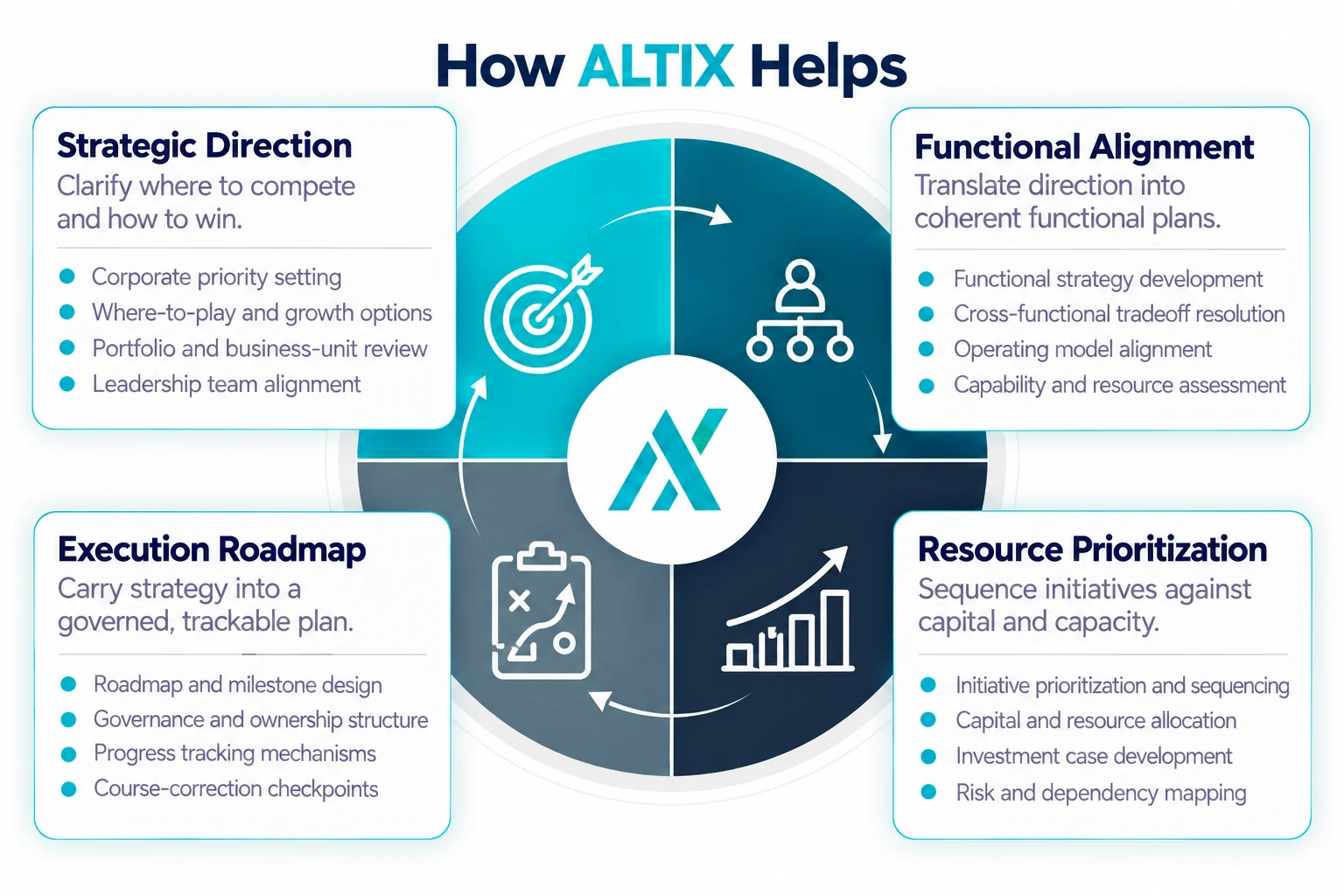
Strategic Direction
- Corporate priority setting
- Where-to-play and growth options
- Portfolio and business-unit review
- Leadership team alignment
Functional Alignment
- Functional strategy development
- Cross-functional tradeoff resolution
- Operating model alignment
- Capability and resource assessment
Resource Prioritization
- Initiative prioritization and sequencing
- Capital and resource allocation
- Investment case development
- Risk and dependency mapping
Execution Roadmap
- Roadmap and milestone design
- Governance and ownership structure
- Progress tracking mechanisms
- Course-correction checkpoints
Featured content
Selected perspectives, interviews and solutions relevant to your priorities. Explore how industry leaders and ALTIX experts approach the challenges shaping industrial transformation.

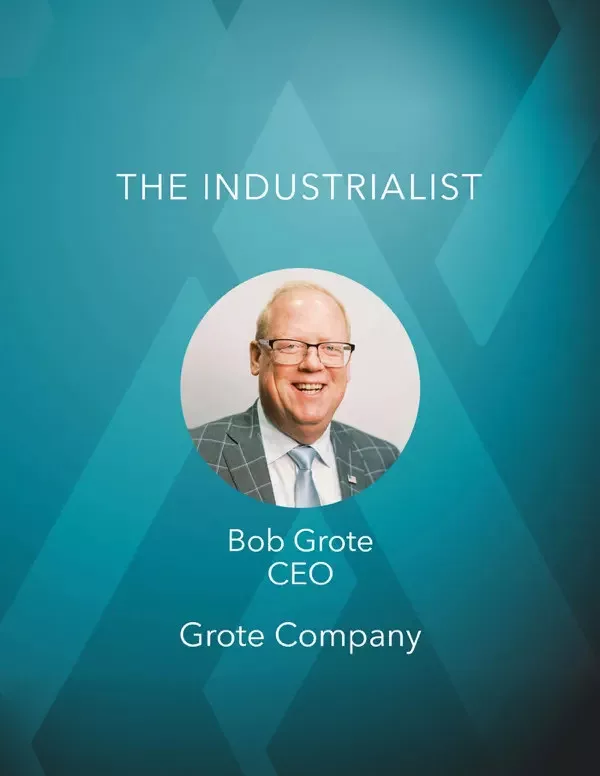
Can Love Make You a Better CEO? Bob Grote Thinks So. A Conversation with Bob Grote, CEO of Grote Company
Listen now
Frequently Asked Questions
What is the difference between corporate strategy and functional strategy?
Corporate strategy decides where an industrial company competes and how it grows. Functional strategy decides how operations, supply chain, commercial, technology and HR must work to deliver that direction. Problems start when the two are written separately. A plan to grow in a new region fails if operations, supply chain and commercial are still optimized for the old one. A useful test for the corporate level is whether the vision is concrete in four dimensions: customer, product, industrial process and supply chain, each tied to a date. A vision that concrete tells every function what to say no to.
When should an industrial company revisit its corporate strategy?
Revisit it when the operating assumptions underneath it change: tariffs or trade rules, customer demand geography, technology, ownership, or a major acquisition. Do not wait for a fixed calendar cycle or for margins to fall. Once performance drops, options narrow and the cost of change rises. A lighter alternative to a full refresh is a quarterly board check built on three questions. Which of our assumptions depend on a world that no longer exists? What is our cost of inflexibility, and who owns reducing it? Are we becoming more or less relevant to where our industry is going?
Why do strategic plans fail during execution in industrial companies?
Industrial strategies rarely fail because the direction was wrong. They fail for five recurring internal reasons: misaligned incentives, weak governance and sponsorship, execution slippage, communication breakdown, and cultural resistance, the organization’s immune system rejecting the change. All five can be anticipated and fixed. Research by McKinsey and John Kotter puts the failure rate of large transformations at roughly seven in ten. ALTIX designs strategy work so that ownership, sequencing, incentives and a governance rhythm are part of the plan from day one, rather than handed to a separate implementation team afterwards.
How many strategic priorities should an industrial company have?
Three. Not five, not seven, and certainly not fourteen. When everything is labeled critical, nothing has been chosen, and the trade-offs leaders avoided get made chaotically on the shop floor instead. Three priorities is few enough for every manager to repeat and for the CEO to defend in person. It is also enough to move a mid-market company meaningfully within a year. Review the list at least annually and replace priorities without sentiment once they are delivered. The Superfit Company calls this “the discipline of three”.
What does a good strategy execution roadmap include?
A good execution roadmap turns strategic priorities into a sequenced set of initiatives with named owners, timing, resources and measurable milestones. It also makes dependencies between functions explicit. Many industrial companies use Hoshin Kanri and its X-matrix to connect three-year breakthrough objectives to annual targets, monthly milestones and owners, backed by a monthly one-page A3 review. The roadmap should match the people and money that actually exist, and should sequence foundations such as standard work and data before the initiatives that depend on them. Without that level of detail, strategy remains a set of intentions.
Let's discuss your priorities.
ALTIX works alongside industrial leaders to turn strategy into results that create lasting value.