



M&A Strategies & Post-Merger Integration
Acquire with conviction. Integrate with discipline. Capture the value.
Industrial acquisitions create value on paper far more often than they create it in practice — the gap is usually integration, not the deal itself.
ALTIX helps industrial companies define acquisition strategy, run disciplined diligence, and execute post-merger integration that protects and builds enterprise value.
Executive Perspective
Signing is the starting line. Integration decides the outcome.
Industrial M&A succeeds or fails largely after signing — in how quickly two organizations align operating models, retain critical talent and customers, and capture the synergies the deal case assumed.
Many acquisitions are evaluated on strategic and financial logic alone, with integration planning starting only after close — by which point momentum, talent, and customer confidence are already at risk.
Acquisitions that sustain their value are the ones where integration is planned before the deal closes and executed with the same discipline as the transaction itself.
Common challenges
How ALTIX Helps
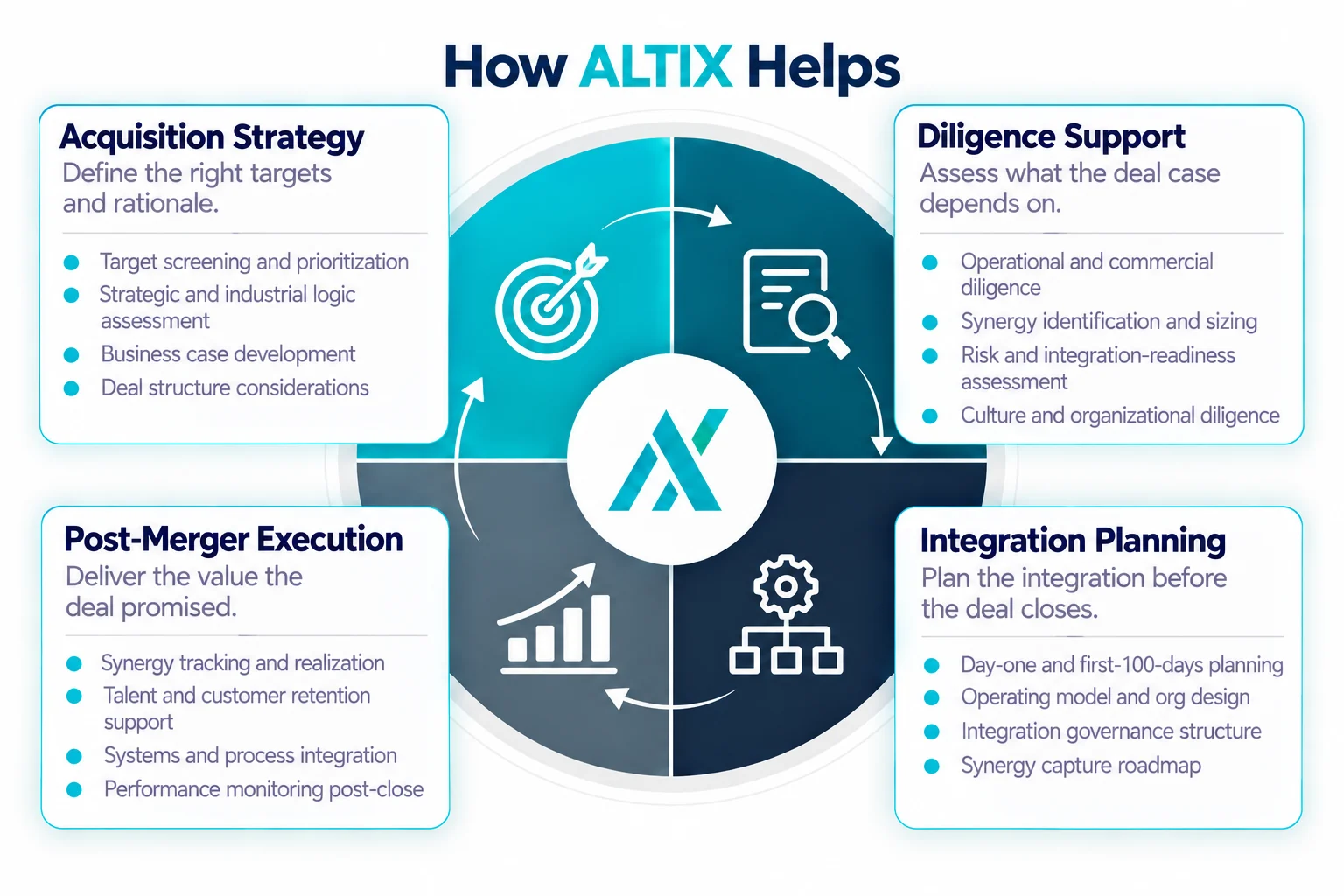
Acquisition Strategy
- Target screening and prioritization
- Strategic and industrial logic assessment
- Business case development
- Deal structure considerations
Diligence Support
- Operational and commercial diligence
- Synergy identification and sizing
- Risk and integration-readiness assessment
- Culture and organizational diligence
Integration Planning
- Day-one and first-100-days planning
- Operating model and org design
- Integration governance structure
- Synergy capture roadmap
Post-Merger Execution
- Synergy tracking and realization
- Talent and customer retention support
- Systems and process integration
- Performance monitoring post-close
Featured content
Selected perspectives, interviews and solutions relevant to your priorities. Explore how industry leaders and ALTIX experts approach the challenges shaping industrial transformation.

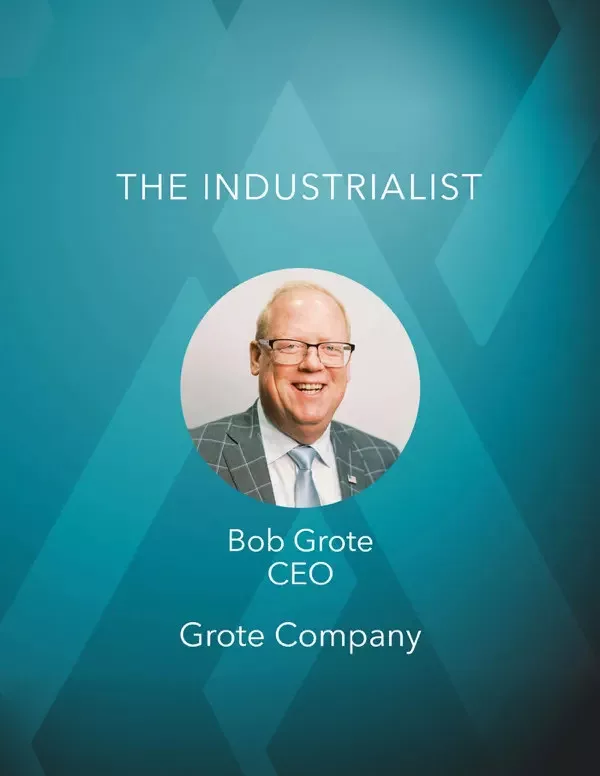
Can Love Make You a Better CEO? Bob Grote Thinks So. A Conversation with Bob Grote, CEO of Grote Company
Listen now
Frequently Asked Questions
Why do many industrial acquisitions fail to deliver expected value?
Most value lost in industrial M&A is lost after closing, not at signing. The usual causes are integration planning that starts too late, operating models and production systems left unaligned, synergies that nobody owns or tracks, and cultural friction between plants and management teams. Cross-border deals add a further layer: a US acquirer and a European target, or the reverse, bring different labor rules, works councils, decision styles and reporting habits. ALTIX has supported acquirers in precision aerospace and industrial equipment in connecting the deal thesis directly to integration execution.
What is post-merger integration for a manufacturing company?
Post-merger integration (PMI) is the structured process of combining two organizations’ operations, systems and people after an acquisition closes, so that the value in the deal thesis actually appears in the numbers. For manufacturers it usually means aligning production systems, quality management, supply chains, ERP and management routines across the combined plants without disrupting delivery to customers. The work typically runs over 12 to 36 months. The first 100 days decide leadership, governance and the few moves that protect customers and key people.
When should integration planning begin relative to deal close?
Integration planning should begin during due diligence, well before closing. Starting early lets the acquirer decide leadership, operating model and first-100-day priorities in advance, so day one is deliberate rather than reactive. It also tests whether the synergies in the valuation are achievable in practice. A useful rule: if the integration lead has not reviewed the synergy case before signing, the price has not been fully tested. Waiting until close leaves customers, suppliers and key employees uncertain at exactly the moment competitors are most likely to approach them.
How is synergy realization measured after an acquisition?
Synergy realization is measured by tracking each quantified target from due diligence, whether cost, revenue or working capital, against actual results on a fixed timeline, with one named owner per target. Reporting should separate banked cash, run-rate and forecast, and no saving should be claimed by two workstreams. We recommend a value guardian: an independent role, usually close to the CFO, whose job is to check the integration’s claimed results against the financial record. Without that discipline, synergies that looked certain in the model rarely show up in the P&L.
What should a manufacturer assess in operational due diligence?
Operational due diligence should test what the financial model assumes. That means plant condition and capacity, the maturity of production and quality systems, supplier concentration and resilience, the depth of the management team and key technical people, IT and ERP compatibility, and labor and regulatory constraints in each country. It should also estimate the integration effort and the acquirer’s own capacity to carry it. Many deals are judged mainly on commercial logic while operational integration risk is underweighted. That is how buyers end up paying for synergies they cannot deliver.
Let's discuss your priorities.
ALTIX works alongside industrial leaders to turn strategy into results that create lasting value.