

Supply Chain Transformation
Plan with precision. Source with resilience. Deliver with consistency.
Industrial supply chains are being tested by volatility in demand, supply, and cost — and many networks built for stability are now exposed by disruption they weren’t designed to absorb.
ALTIX helps industrial companies transform end-to-end supply chain planning, sourcing, logistics, and inventory to perform under real-world conditions.
Executive Perspective
Resilience and efficiency are not opposites — but most networks are built for only one.
Industrial supply chains optimized purely for cost often lack the flexibility to absorb disruption, while those built purely for resilience can carry excess inventory and complexity.
Many supply chain problems that appear to be execution issues — missed deliveries, excess inventory, stockouts — actually originate in planning assumptions, sourcing structure, or network design.
The companies that perform best treat supply chain as an end-to-end system — planning, sourcing, and logistics managed together, not as separate functions optimizing in isolation.
Common challenges
How ALTIX Helps
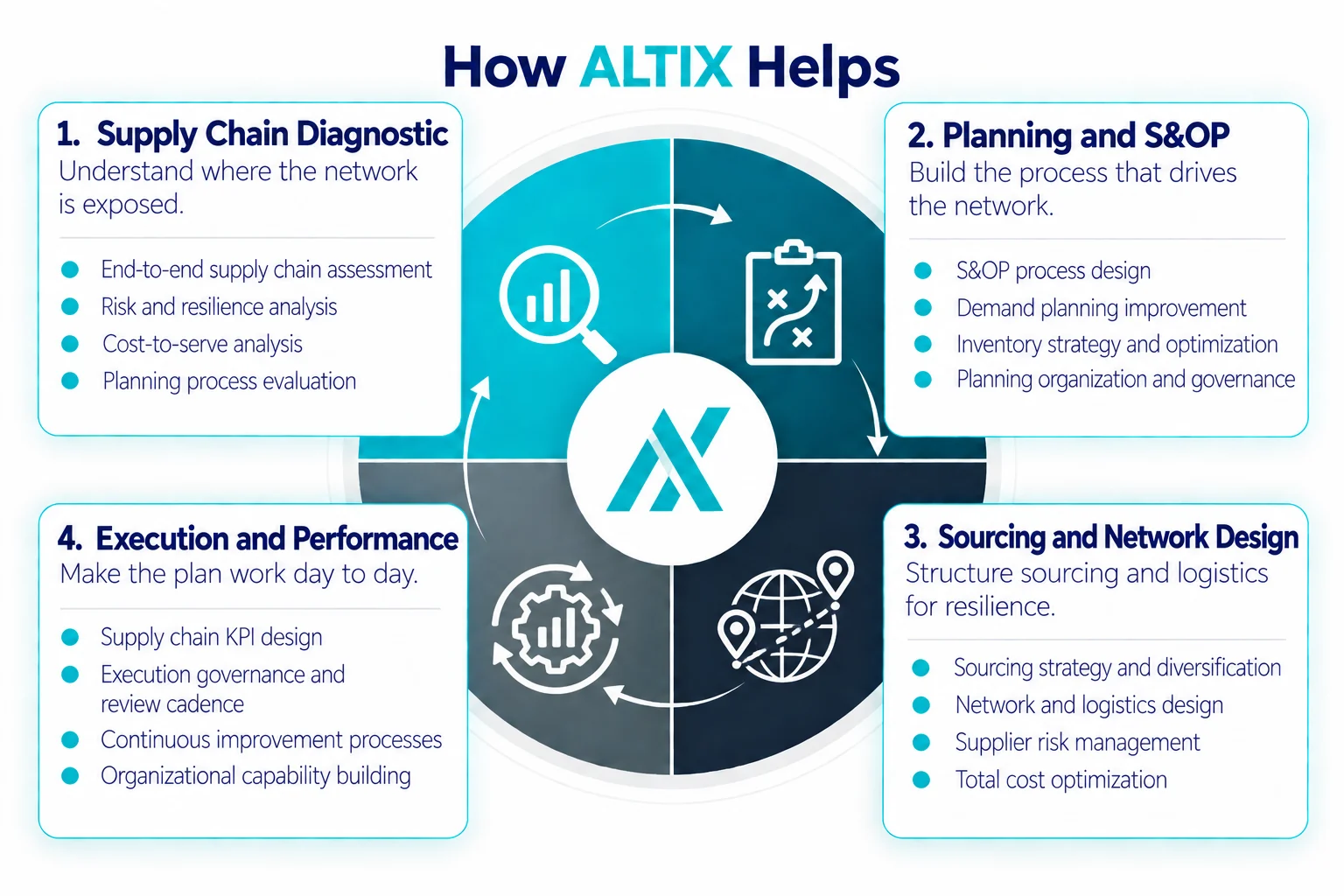
Supply Chain Diagnostic
- End-to-end supply chain assessment
- Risk and resilience analysis
- Cost-to-serve analysis
- Planning process evaluation
Planning and S&OP
- S&OP process design
- Demand planning improvement
- Inventory strategy and optimization
- Planning organization and governance
Sourcing and Network Design
- Sourcing strategy and diversification
- Network and logistics design
- Supplier risk management
- Total cost optimization
Execution and Performance
- Supply chain KPI design
- Execution governance and review cadence
- Continuous improvement processes
- Organizational capability building
Featured content
Selected perspectives, interviews and solutions relevant to your priorities. Explore how industry leaders and ALTIX experts approach the challenges shaping industrial transformation.

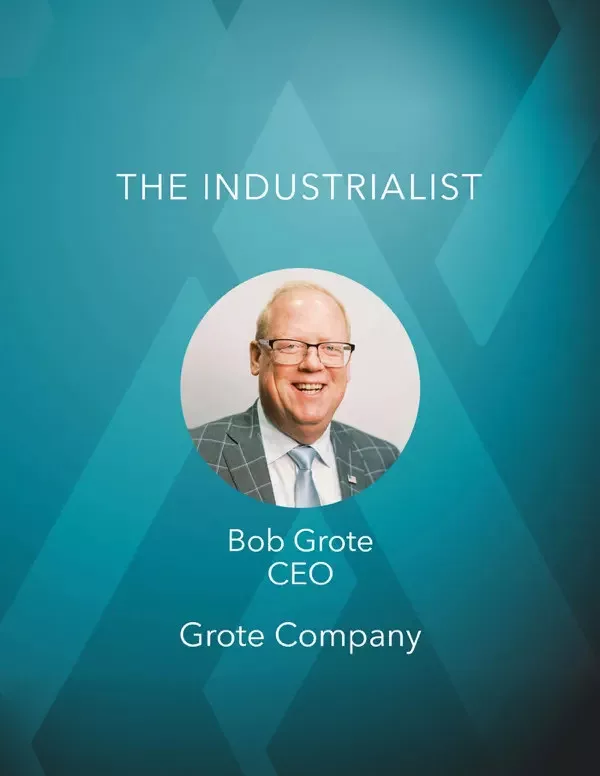
Can Love Make You a Better CEO? Bob Grote Thinks So. A Conversation with Bob Grote, CEO of Grote Company
Listen now
Frequently Asked Questions
What is supply chain transformation, and how does it differ from supply chain management?
Supply chain management runs the existing chain day to day. Supply chain transformation redesigns how the company plans, sources, produces and delivers, to fix structural gaps in service, cost, working capital and resilience. It becomes necessary when incremental improvement no longer closes the gap, or when the environment has changed underneath the design. Supply chains built for lowest cost in a stable, open world now face tariffs, export controls and repeated disruption. The question has shifted from “where is it cheapest?” to “where is it safe, and how quickly can we adapt?”
What are the warning signs that a supply chain needs to be redesigned?
Typical signs are stockouts in one place alongside excess inventory elsewhere, frequent expediting and premium freight, poor forecast accuracy disrupting production plans, low on-time-in-full (OTIF) performance, and repeated disruption from single-source suppliers or fragile logistics routes. A persistent gap between what sales forecasts and what operations can deliver is another strong signal. These symptoms usually come from the structure of the planning process or network design. More effort from the same process will not fix them.
How do you improve supply chain resilience without significantly increasing cost?
Target resilience where the exposure really is instead of adding inventory or capacity everywhere. Map which suppliers, components, routes and plants would cause the greatest business impact if they failed. Then act selectively: qualify second sources for critical items, improve demand and supply visibility, build flexibility into planning, and set stock buffers by risk. Measure the result as resilience per dollar, not only cost per unit. A second source costs more per unit, but it is often the highest-return investment on the list the day the single source fails.
What is sales and operations planning (S&OP), and why does it matter?
Sales and operations planning (S&OP) is a monthly process that aligns demand forecasts, production capacity, inventory and financial plans, so that sales, operations and finance work from one agreed plan. Integrated business planning (IBP) extends it to strategy and full financial reconciliation. It matters because gaps between what sales expects and what operations can deliver cause most stockouts, excess inventory and firefighting. A good S&OP process is short, data-based and decision-oriented. It ends with owners and dates, not just a shared forecast.
How do you reduce inventory without increasing the risk of stockouts?
Reduce inventory precisely rather than across the board. Segment products by value, demand variability and criticality, set stocking policies for each segment, improve forecast accuracy and demand visibility, and shorten replenishment and production lead times. Uniform reduction targets usually cause shortages of critical items while slow movers stay untouched. Done properly, inventory reduction releases cash while service improves, which is why it belongs in the cash ledger of any transformation business case.
Let's discuss your priorities.
ALTIX works alongside industrial leaders to turn strategy into results that create lasting value.